Pages

Thursday, September 29, 2016

Picturing The Meaning of Life

In unit of 1 of my Humanities class Journalism, we learned about the what being a journalist means; we also looked at photo journalism, and how you can tell a story with one photo. For an FE, we went to Wienberg Newton Gallery, and we looked at an exhibit with photos of the spots where someone was shot in Chicago. This was really in impactful to see how one image can old so much meaning behind it. As for our action project, we had to interview someone about the meaning of life, and take a photo of them. This photo could just be them in their natural environment, but I decided to do something different. What I found challenging for this project was thinking of the right picture to take, and showing that the picture has meaning behind it. I am proud of the image that I ended up using because I put a symbolism into it. Below you can learn about the interview I took and see the picture I used. Please enjoy!


There are so many things happening in our world right now, every few seconds someone dies, someone is born. The planet is changing, we are evolving. But--What is the meaning of it all? Why do we do the things we do, why does the earth move it does? What is the meaning of life? Just ask yourself that.

I asked myself that, and then I went out to interview someone to ask them the same thing. The man I am interviewing is AA, my father. He is 57 right now, he is married, he is works for the City of Chicago as an architect. He has sister and brother, both living life happily. He is very involved in the Greek community, going to church, parades, and any special events. He is always giving a happy vibe to everyone around him. I thought he would be perfect to interview, because he has experienced so much, and still has such a happy face.

I asked him, “What is the meaning of life?” he responded with, “It is to able to leave good thoughts behind so people can continue to do good deeds and be smiling as they do so. I say this because now of days everything, TV, newspapers, and social media are about disasters, murders, it is all bad news with no good thoughts.” I really liked that response because I believe the same thing, there is too much bad in our world.

I followed with a question that, I think, is very important, “How do you represent your meaning of life?” He replied with (speaking in Greek), “Do good and good comes back to you.” Let me explain first why I think that was important question. These days, a lot people will say something or judge someone and not follow what they said. I knew he was going to say that because I always hear him saying that to me. He even says it to others. They will ask why he does certain things, and he is never hesitant to say, “Do good and good will come back to you.” Next I asked if he was taught to believe this because he taught it to me. He answered with, “You aren’t really taught you are mentored that way from everyone, and everything around you.” I connected a lot with this answer, because it is true, the people, the area, that you live around really makes you the person you are; it does this either in a good way or bad way.

Speaking of that, my next question was, “What’s your advice to people that have bad all around them?” He responded with, “Time will tell and everything will work out.” I expected something different, but I was happy with what he said. I say this because a lot of people think where the place they are is where they will be forever. This isn’t true, if you work hard and always keep a positive attitude it can change for you, change for the better. Lastly, I asked him, “Has your definition changed overtime?” He was quick to respond, saying, “My definition has gotten stronger in a positive way. It has changed for the better.” This is an answer that I was surprised to hear, mainly because so much can changed in 57 years; you might define something differently than you did 20 years ago.
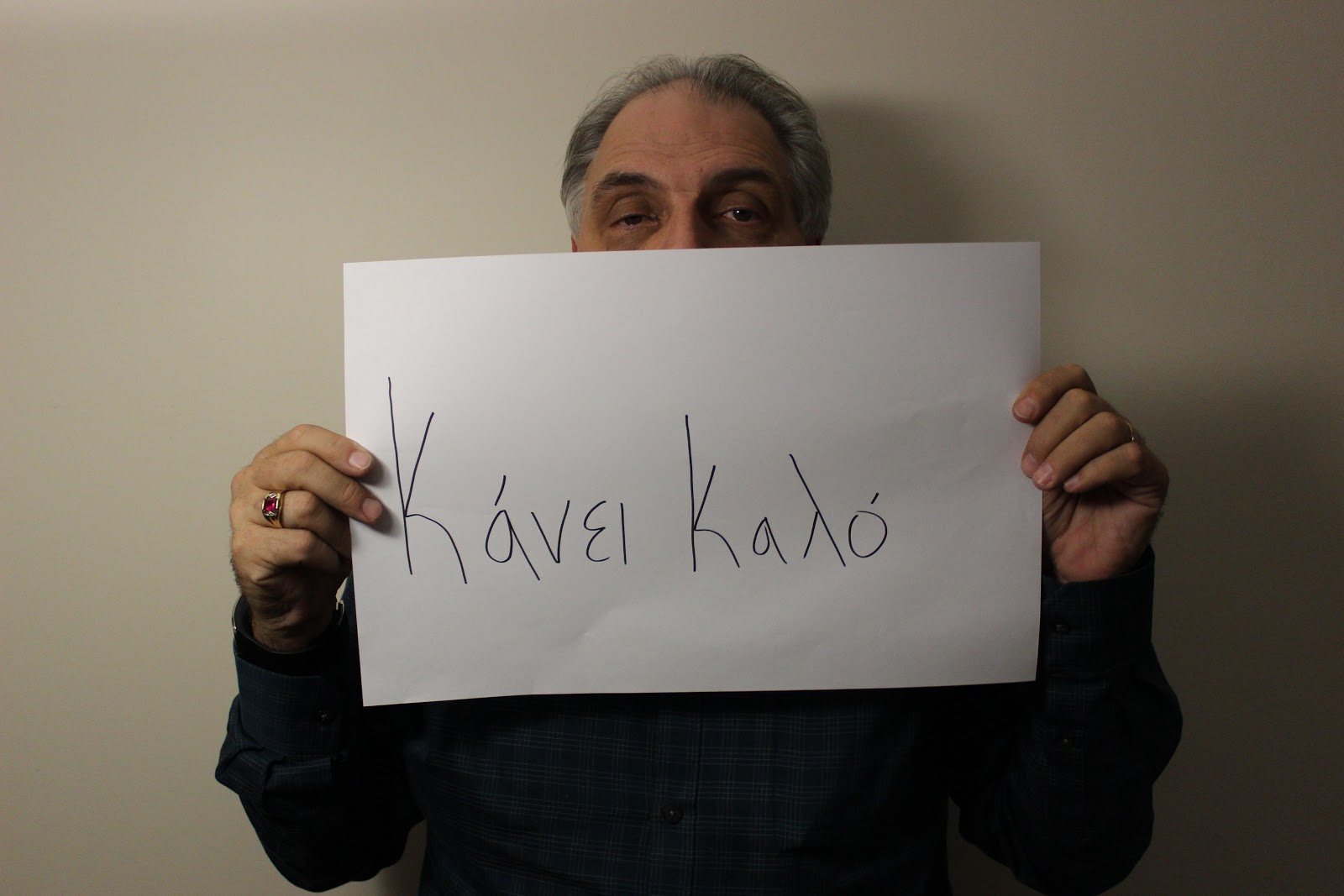
NVA. "DO GOOD." 2016. Chicago
Above is the image I have chosen to use for this article. I used this one because I liked the symbolism behind it. The first piece of symbolism is the how the dark the image is, and the background. I did that because he was saying there is so much bad news, bad news you see in: social media, newspapers, and TV. Now, you might be wondering what the sign he is holding is saying. Well, that is Greek, and it translates to “do good” which was his message during the entire interview. I also had the light focusing on that sign, so it shows how much he tries to represent that. In addition, he is only showing half of his face, because it adds to the realness of the situation, how he always tries to do good, that it is normal to him. He just does it, without any expression, he just wants to spread good, positive views.

When it comes to the aperture, shutter speed, and focus, I didn’t really do anything special with those aspects in the use of the camera. I really just played around with the lighting around me to get that darkness, and light look. For me, this pictures makes me use my 5 senses and think of something smooth a crisp, I say this because the image is very simple (smooth), but the meaning is very powerful (crisp).

In the end, I really took away a lot from away this interview, I knew some of this information already. It was still nice to hear him explain it more and go deeper in his meaning of what life, and how he always wants to do good. Now go back to what I asked in the begining on what your meaning of life is. Has it changed? Or has it got stronger?


References:
Personal Interview. AA. 2016.

Tuesday, September 27, 2016

Directing My Life

In unit 1 of my STEAM class Economics, we learned about opportunity cost and how everything has a price: your time, your choices, and your passions. It was heavily filled with concepts of how people think and incentives. From a math point of view we went over calculating interest, such as compounding or continuously; another thing we touched on was matrices and how they work. One big thing we looked over was Supply and Demand and how a graph of that works. For FEs, we went to the Federal Reserve Bank to talk about how they work, and how they really control the economy. For our action project we had to pick a future job and think about two routes to get there, and make a presentation about all the costs that go into it. The career I chose was a film director, because it is something I have always wanted to do. The purpose of this was really to help us map out our future using what we learned. It wasn't just for a project, this helped us a lot in mapping out our lives. My main challenges were getting the correct information and how to put it all together. I am the most proud of getting to finish it on time, and using my time productively when doing this. Below is a Soundcloud of me explaining my two routes and below that my presentation, thank you!


Friday, September 23, 2016

Glimpse of Glimpse

Over the summer of 2016, I was fortunate to be accepted to a program called Global Glimpse. With Global Glimpse I traveled to the Dominican Republic for 18 days with one other student from GCE Lab School; in total there were 20 students and two teachers from different high schools in the Chicago area. The city I traveled to in the Dominican was Bonao, which is in the center of all the mountains The main purpose of this trip was to work with local people teaching children to speak English.

Teaching wasn’t everything, we got to experience the lifestyle of the locals and how one area of the Dominican was different from another. Our experience in the Dominican highlighted differences of living in the United States. There was no hot water for showers, so it was a cold bucket shower everyday; which to me wasn’t so bad, because the weather was so hot. We couldn’t drink the water there so we had special purified water made for us and we couldn’t eat street food, only the food that was made for us, or any place they said is safe. Everyday was different, where we could learn and do different things, for example we had a “Living like a local day” where we actually had to live like a local. This meant less food for the day, no lighting in the place we stayed at and no fans to cool us down. Or “Working like a local day” where we went out to help plant plants. Another example was “Imigration day” this day we got to meet a Dominican village where all the people came from Haitian descent and we got to see how Haitians were viewed by a lot of Dominicans.

Not everyday was like this. On Wednesday we had a fun day and on our first fun day we hiked to a waterfall. We also had Free days, where we got to go out in a group of four people and shop and just walk around Bonao. We did so much in just 18 days, and it was truly amazing. But I want you to walk away with an important lesson that I learned, these people while living in “poor conditions” don’t need our help. They want us working with them, and being a team; not just helping them a little and going away.

The last days were for our Community Action project (CAP), where we were presented with many different ideas of what we could to do by the locals. The one idea that caught our eye was building a playground so they didn’t have to play in the street. We did this by donating money and then we used that money to build the playground. We never got to finish but we did so much that the locals were very happy and couldn’t wait to complete it for us. Not only did we build this playground, but we had enough money to buy a deep freezer for another CAP, so our delegation was able to do two CAPs in the span of two days! Below is a slideshow with pictures of my trip, please enjoy! If you want to see more go to this link of a video I made of the trip: https://www.youtube.com/watch?v=tF4dL-HW3xg.

Thursday, May 26, 2016

One Man Army

In unit 3 of Policy we learned about what the judicial branch is, who it consists of, and the powers it can hold. We focused mainly on the Supreme Court and its involvement in the the checks and balances of the three branches. Also we reviewed Supreme Court cases and how they all challenge what the Constitution states. For the action project we had to choose a Supreme Court case and make a presentation on it, which consists of the historical context, looking at both sides of the argument, and if we think it was just or unjust. I chose research the Korematsu v. United States (1944), which had to deal with Japanese Americans being put in internment camps. I decided to this case, because when reading about it, it challenged me to think if it was just or unjust. Something I enjoyed about this action project is that it is in presentation form, whereas the previous action projects have been essays. A challenge I faced was being able to pick a case, because there are so many that it can be hard to find one that interests you. I hope you like reading about Korematsu v. United States!

Speaking Espanol

For my third period class, we went over speaking Spanish, but we did this by going over these topics: Spanglish, immigration, Latin American literature, influence on Chicago, food, and art. For this action project we had to write an essay in Spanish about one of the topics we went over, with an art visual. I chose to do Spanglish, because I like the concept of mixing languages, and I see it being used a lot more in popular media. With doing this we also had a 2 to 3 minute talk with our teach in Spanish about our topic. Something I liked about this project was getting to chose whatever topic and visual aspect to make this project to our liking. Something that challenged me was making an essay about Spanglish without repeating a statement over and over again. Hope you enjoy reading about what Spanglish is!

Becoming An Urban Planner

In unit 3 of Urban Planning, we focused a lot on the “flow” of a city, and how that can affect our society today and the people living in it. We watched three TED Talks on how today’s urban environment is not worth fighting for, is boring, needs to be retrofitted, and how it has led to segregation. For the action project we had to pick a block in a town/city and choose what flaws it has and how we can improve it. I chose a block right by my school. This is very industrial and bland looking, and I want to see how I can make it better. Something I liked about this was getting to choose a block anywhere in the city because it gives the class so much freedom. Something that was challenging was getting the volume for the buildings and doing the 3D model, only because it was very time consuming to get it perfect. Hope you enjoy!


The area I have chosen is around the intersection of Concord and Throop. This is a very industrial area, which houses the Fleet and Facility Management (2FM). They fix Chicago city vehicles and have architects for city building in this area. I would say that there aren’t any strengths in this area. The weaknesses are that it barely has any nature, and there are a lot of big blank walls and skinny roads, with skinny sidewalks. To make this area better I would put some art on these walls to make it more welcoming, even if it is a city space. I would add more green by putting green roofs on the ceilings so that during the summer workers don’t get too hot. Also, I would make the sidewalks bigger, and put plants around them.

The shape of the area I would like to fix up is a trapezoid, the bases are 553.73 ft and 906.14 ft, and the height is 1,045.38 ft, meaning that the area is 754,675.11 ft squared. Below is a picture of the space from google maps. I have labeled what I think is wrong with it.


NVA. "Google Maps Design" (2016) 
But what should be done? Well on the roofs I would put solar panels and green roofs to get more energy and make sure the building doesn’t use extra. I would put art on the walls to make it look very welcoming, and widen the sidewalks, then add more greenery. Below is a scale drawing of my new design plans.

NVA. "2D New Design" (2016).
I was inspired a lot by James Kunstler, Ellen Dunham-Jones, and Majora Carter who all three gave TED talks on how they could/would change the urban planning we have now, and make it better. James inspired me by showing how blank walls can make an area look very bad and “not worth fighting for”. Ellen helped with showing how walkability in an area is so important for people, and it can affect how a space feels. Majora showed me cool roofs and green roofs which are good for energy saving and they look very nice as well.

My new designs will change a lot about the flow with this small area, but how? Well for transportation it makes walking nicer and gives the pedestrian more space to move. It will change the buildings by adding some nice art and adding green roofs and solar panels. Once the green roofs and solar panels are installed it will change the electricity/gas usage and save money, for when it is winter the heat/cool can stay in so they don’t waste electricity/gas. When the solar panels are up, since the building’s roof has a triangular point it will catch more sun, giving the building more energy. Lastly for infrastructure, the roads will be a bit slimmer but vehicles will still have room to move with both sides of traffic being able to move at the same time.

Now to get to the 3D aspect of it, the two main buildings of the area are the Fleet Department building, and the old fire house. So I got the volumes from people who worked there and they said that the Fleet Building was 24,296,300 ft cubed, all I need was the height. So I got the area from google maps which was 388,439.61 ft squared, then I just divided that to get my height which is 62.54 ft. For the old fire house they said the volume was 60,000 ft cubed, so using google maps I found that the area was 1,981.21 ft squared and when I divided those two numbers I got 30.28 ft as my height. Below is a 3D model of my design, made with Tinkercad.

A main problem I had was just doing the sketch and finding out the volumes. I overcame the sketch by trying my best, and asking for help from the teacher. I overcame the volumes, because I was able to find them out from the people working there, but I needed to show the area and height as well; so what I did was use those volumes, find the area on Google Maps, and then divide the numbers to get the height. What I learned from both is that you can always find a way through something, you just need to work hard and not give up. I wouldn’t want to do anything differently, I am very happy with the designs I have created.

Sunday, May 15, 2016

Just War

In unit 2 of Policy, we focused on the executive branch, such and the powers and different abilities it has. We also looked the Vietnam War, and the different things it did to people and how the executive branch can make policies that are unjust, like war. For an FE we went to the International Veteran’s Art Museum, where we looked different art work representing the Vietnam War. We also got to try on some gear that veterans had to wear while in battle in an exhibit inspired the book we are reading, The Things They Carried, by Tim O’Brien. For the action project, we had to choose a war and explain if it is just or unjust, and explain our reasoning. I picked the Civil War because this is a war that is a very old war, and show how it had a lot of ripples that lead into the present day. Something I liked about this project was getting to select a war of any kind, even if it wasn’t an actual physical battle. Hope you enjoy reading about whether or not I think the Civil War is just or unjust!


The American Civil War, fought in between the north (Union) and the south (Confederacy), lasted for four years, from April 12th, 1861 through May 9th 1865, not a war that the United States joined but a war that was in the center of the United States, dividing our nation. A war that would push a ripple effect on our society, a ripple that is ongoing. The war was the first where slaves could fight if they had become free. This also was a war that brought our nation together and ended slavery in the United States. But why did this war happen? Mainly it was tensions between the north and south about what was right and wrong, like whether or not slavery should exist. A lot of underlying causes were the Underground Railroad for slaves to use to escape to the north. Also the Dred Scott case of 1857, declaring African Americans not citizens of the United States. The Missouri compromise of 1819, separating free states and slave states. But that was just putting gasoline on the wood, the match to start the flame was on April 10th, 1861 when in Fort Sumter and a firefight broke out between the north and south, marking the start of the Civil War.

Was it good we went to war, or should we have tried to make this civil conflict more peaceful, since this was the war with the most deaths so far? I believe this war was just, and needed to happen because it got people out of the state of treating others as literal property. It ended something that should have never been a to begin with, but was sadly. It gave the line, “All men are created equal” more truth in the Declaration of Independence. This war was a declaration in it’s own way, asserting that slavery is wrong and needs to stop, and our nation has to begin working together again.

The President at the time of the Civil War was Abraham Lincoln, and during his first inaugural speech said that we need to get the south to become part of the Union again, to have the nation working together; this was a month after after the war started. This also had a lot to do with Lincoln’s want and need to end slavery in the United States. Congress played a huge role in this war, in 1861 Congress created the Joint Committee on the Conduct of War. Where a group of people from the south and north would give intel on the war and everything else that was going on that they might need and should know.

During this time two big policies were made, the Conscription Act of 1863, and the Militia Act of 1862. The Conscription Act meant that every man between the ages 20 - 45 must register to be a soldier, even if they were about to become citizens. The Militia Act meant that freed African Americans would work as laborers and soldiers in the war. Both policies were created by Congress, mainly to get more soldiers for the Union. The Conscription Act was hated by many people and resulted in a lot of protesting in New York, whereas the Militia Act had many African Americans ready to sign up and ready to fight, to show their pride. Both these led to the reason why the American Civil War had the most deaths of any war that the United States has been a part of. I say on a legal and logical standpoint that Congress was just for making these policies, because they needed to be made for the Union to have won the war. Plus the acts didn’t go against any policy previously made, in fact it helped one act that was made during the Revolutionary War, saying that all men needed to have a weapon in preparation of war. I say this because it showed how the government need all these acts to secure the victory in the end.

In conclusion, this war was just and needed to happen to make a step to a better society, one where we could work together. President Abraham Lincoln was right to have wanted to free slaves for the greater good, and to bring the south back to the Union. If not, then we might not have won a lot of the wars that we did in the not-so-far future. This might have had the most deaths, and did have ripples both good and bad. But it did lead to the great migration, where many African Americans were able to get good jobs that they could survive well with. Also leading to more change that was for the good. This war needed to happen, and it moved us on.


References:

"Causes Of The Civil War | HistoryNet." HistoryNet. Web. 11 May 2016.

"African Americans In The Civil War | HistoryNet." HistoryNet. Web. 11 May 2016.

"Abraham Lincoln." Council on Foreign Relations. Council on Foreign Relations. Web. 11 May 2016.

"Congress Passes Civil War Conscription Act." History.com. A&E Television Networks. Web. 11 May 2016.

"U.S. Capitol Visitor Center." U.S. Capitol Visitor Center. Web. 11 May 2016.

"The History Engine." History Engine: Tools for Collaborative Education and Research. Web. 11 May 2016.