In Unit 1 of my Cure course, we learned about different ways to approach math problems like substitution and elimination, but most important we learned how cells work in the body. We also learned the different parts and the organelles inside of the cell and what they do. For the action project we had to create a Prezi presentation on a surgery of our choice and explain the organs involved and the cells they are made up of, and what happens in the surgery. I picked the replacement of a disk in the back, mainly the lower part, and I thought this would be could because of how serious it can be if the surgery were to be done wrong. The purpose of this project was to see how different cells in the body have very different ways of working and to show in a real life situation.
Sunday, April 19, 2015

Thursday, April 16, 2015
Kate The Tamer!
For Unit 1 of my Drama course we read Taming of The Shrew, written by William Shakespeare, and we talked about how the 16th century had such a big role in effecting the play he wrote. As Shakespeare grew, he soon went into the role of writing sonnets, mainly because they were popular and he wanted money for his. Bringing me to the action project, we had to write a sonnet directed towards a character in the play. In the sonnet it would address them about gender roles in marriage, and how they could use help with it. I chose to write to Kate, the shrew, and tell her about how she needs to make her relationship with Petruchio more equal. Enjoy the poem!
“My hand is ready, may it do him ease”
Did you mean that, or did you just say that to please?
Your power, your shrewishness, your pride, you forswear
when fitted for a hat you loved, from your head, you let him tear
Why let a man tame the only thing that makes you whole?
Instead of looking under the tree to find the present, you looked down the stocking to find the coal
You are the bondmaid,a jest, and the doll that was tied to strings when you met
You are the bug and he was the knave with a net
Stand up for yourself, become equals using your stomach, your air
When standing up you become peaceful, stopping the attack, and make it all fair
Tame the tammer and let him see and learn
He will learn not to have tried to tame the powerful, and he will burn
Have you learned what I am saying, make it equal don’t let someone control everything
You are strong and free willed, and soon to be, lovingSunday, March 22, 2015
Why We R Naught Wanting Smallpox to Happen Again!
In unit 3 of my Disease class, we learned about, the different type of epidemic and the levels that one can reach. We also learned about R naughts, which is how many people can get sick/infected from one person. Next, we learned about correlation and causation, correlation is when two events during the same time period have the same rates (one not really causing the other). Causation, is the same thing, but they are caused by one and another. For my action project, we had to pick a disease that has become an epidemic. When we do that, we had to find out what the R naught of it is, where it has happened, and talk about factors that might lead into it. The purpose of this was to see how some epidemics are caused by a lot of different things, and to see how infectious one can be. The disease I chose was smallpox, mainly because I have always been interested in how it was used as biological weapon for war a lot, and wanted to know why they use that one. The only real challenge to this was mainly that, it was hard to find different factors, that would be on a certain website we used to make our graphs, to correlate the correlation and causation factors of a disease.
Smallpox is an infectious disease, where it can be very hard to know when you have it, causing people to spread it around more. It is a disease that comes from the variola virus, and the incubation period can take from 7 to 17 days. In that time it is able to spread to other people, without them knowing until it is too late. The type of symptoms that will be shown are high fever, vomiting, back pains, those are the starting ones. The one where you know you have smallpox is when a rash starts to form on the head, hands, feet, chest, and soon everywhere; after those that have happened, blisters will start to form on the rashes and they will have a clear liquid in them and soon pus will be in them.
The R naught of this disease can range from 5 to 7, meaning from one person, 5 to 7 can get infected from that person. As I said before, it is hard to tell when you have until it’s too late and you have passed it on to others. From that, it should be able to tell how this can lead to big epidemics. The first cited one was from the thirteen colonies when the British would bring the disease to people that have never been exposed to it before, Native Americans. Soon it started to spread all over the world, but in different time periods, not making it a pandemic, another area in which it has spread would be Australia in 1828. From that date it just proves that disease is really dangerous and go anywhere and be anywhere. The area I want to focus on more is when it was in India in 1974 when smallpox, which was the most recent case of a smallpox epidemic, which happened in January and finished in May. In this time it killed 15,000 people in that time. Now both of those are very dense in population, meaning people would be living together in a close environment, and this is one of the biggest factors. Another factor that should be addressed, is the lack of doctors in some areas, now even if there aren’t in some, we need more doctors to help it be contained or prevented.
It is eradicated today and is not seen anymore because there is a vaccine made for it, but even the vaccine can be a problem; this is because if too many people get the vaccine in one area, it can spread faster than the actual virus itself. In 1979, it was declared eradicated, but it is believed that WHO or the CDC have some samples of it just for study, or for biological warfare. Prevention is one of the hardest things to do since it can spread without anyone knowing, so the main prevention to do for people in that area is stay away from anyone that is showing symptoms, and for a city or the whole area I would actually say to get more people interested in being a doctor, so they know ways to help the community. Just as a prevention tip for everyone is always cleaning your hands so that if you are in contact with someone; or with someone with the disease, if needed to go out just wear a mask so people aren’t contaminated with it.
 |
| NVA "Smallpox Graph" 2015. Gapminder |
The picture above shows how drought, or when water is more available, the disease is more likely to show up in India. This shows, that smallpox could actually appear more when the water is good, meaning people will be drinking water a lot, and when that happens it is easier for people to possibly drink from an infected person’s drink.
 |
| NVA "Areas that have had Smallpox" 2015. Gapminder |
References:
Wednesday, March 18, 2015
Want to Know What Temperature Books Burn At?
For my last unit of Forbidden Books, I got to pick a book that was censored in some time, given to us by our teacher. After reading it, we started to view other people’s books that they chose, and see why that might that might have been censored, by reading some passages from it. Then, why our own book might be censored, and hear other people’s thoughts on the book. The book I chose was Fahrenheit 451, which was written by Ray Bradbury, originally in 1953; I chose this book, because it seemed interesting to me that a book was made about people who personally burn books to stop people from reading them. Leading me to the action project, after we reading this book, we had to write an essay talking about a certain topic, that would show/explain why this books was censored and the theme of the book. The purpose of this was firstly to see why some books are censored, and secondly to see what information they talk about explaining why it might be censored. This was interesting to do, mainly because it showed me how sometimes, some censorships are for really silly reasons; also to see how people want to ban books, that actually have some really good content that we need to learn about. Something that was difficult was having my thesis statement, and making sure that everything I had in my essay would still connect with that statement all the way through.
 |
| Discogangster "Fahrenheit 451" 2008. |
Sunday, March 8, 2015
Dissociative Identity Disorder
For Unit 2 of my disease course we went over learning about diseases of the mind or just mental disorders, the main one we focused a lot on was Autism. For that we learned about Autism is how it affects people personally and how they deal with it. Then we learned about Schizophrenia and how that affects someone, and actually did some simulations for it, just to experience what it can be like. We also learned about the DSM-V, and how that has a lot of mental disorders and is a guide book for psychiatrists for them to diagnosis people with a mental disorder. For our action project, we had to pick a mental disorder and then create a simulation for it to present in class to our classmates. We also had to make a flier containing stats, misconceptions, and ways to seek help. The one I picked was Dissociative Identity Disorder (DID), which is when a person will have separate personalities. The purpose of this was to see how we can make are own simulation that other people can use if they find this. I actually really enjoyed this action project because it was a good challenge to make my classmates see what it is like with Dissociative Identity Disorder.
Scientific Definition of Dissociative Identity Disorder: “Dissociative Identity Disorder (DID) is a severe condition in which two or more distinct identities, or personality states, are present in—and alternately take control of—an individual.” - Psychology Today.
My interpretation: When there are separate personalities in one body, and they act very differently.
“Later, I had another incident. My friend messaged me on Facebook to apologize that she couldn’t make our plans that day. I asked her, “What plans?” She explained to me that we had made plans to hang out. The next time I saw her I told her that we had never made plans. I was sure of it. She showed me the text conversation we had had, and I had no memory what-so-ever of having had that conversation.” - Sherry Polly
Above is a quote that can show what people with this disorder might experience and how it can really affect normal day life. Now people can get this disorder from child abuse at a really young, because since their personalities are still developing they might act dissociate personalities to make this situation in their eyes better.
Flier:

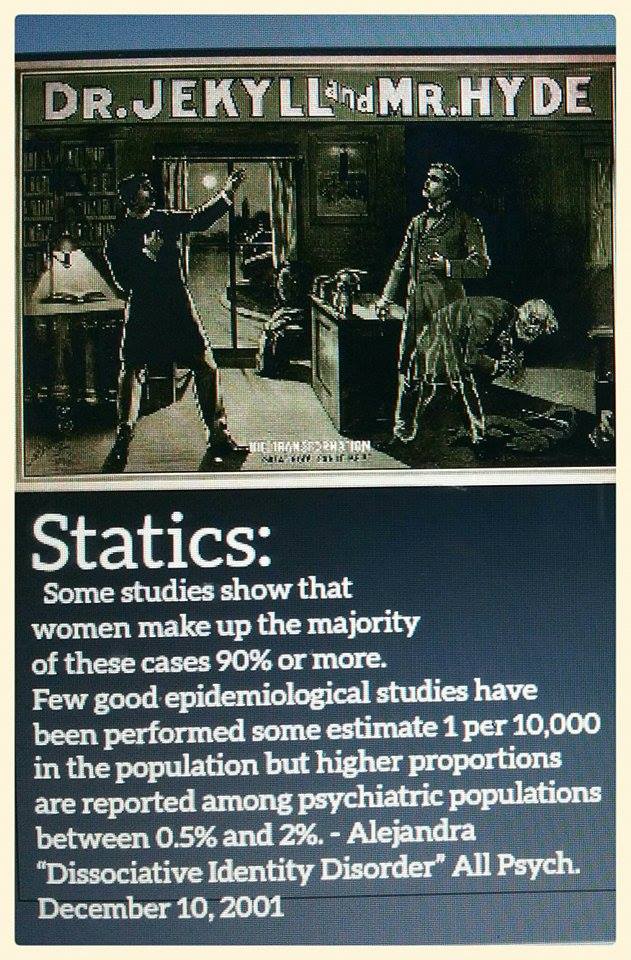
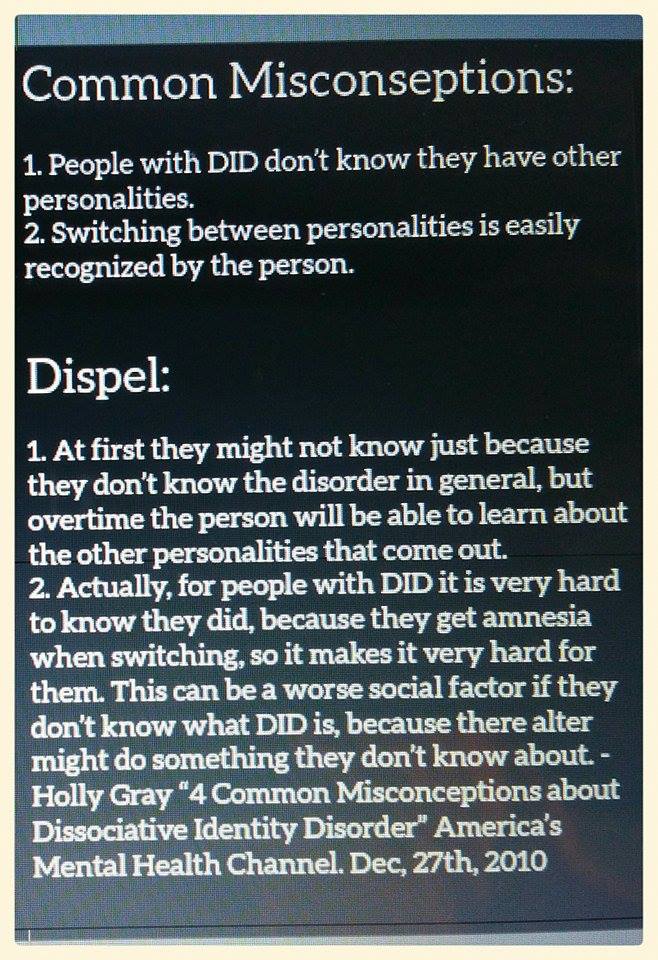
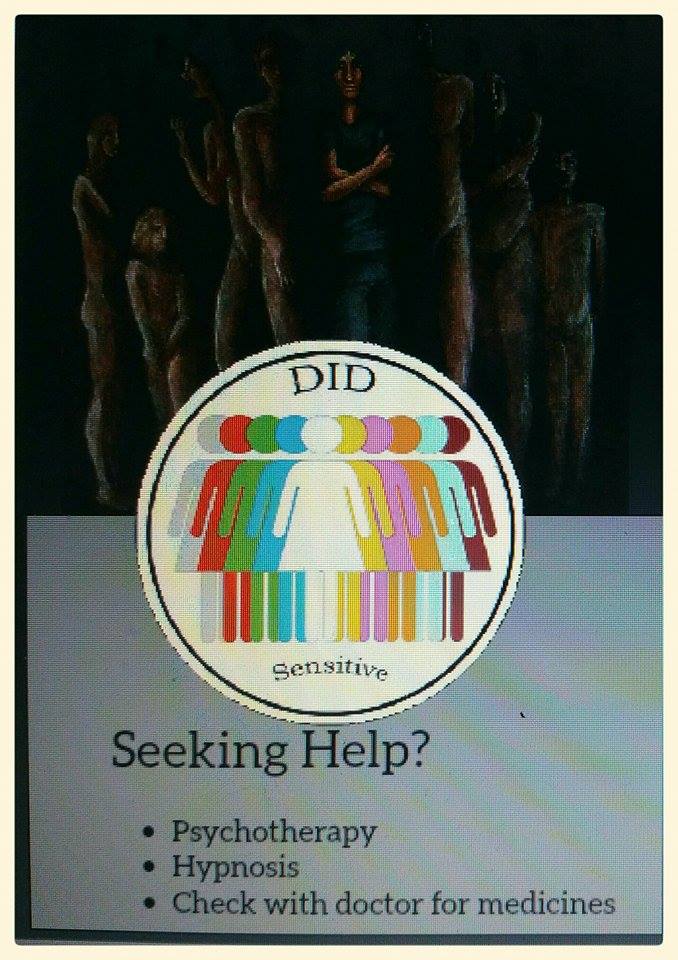
Simulation:
Citations:
Text:
“Dissociative Identity Disorder (Multiple Personality Disorder)” Psychology Today. 11-24-14
Sherry Polly “Losing Time With Dissociative Identity Disorder” America’s Mental Health Channel. Feb 1, 2015.
“Dissociative Identity Disorder” National Alliance on Mental Illness. n.d.
Pictures:
AlwaysAnUnquietMind “Dissociative Identity Disorder” n.d.
04Mukti “Dissociative Identity Disorder” n.d.
Gemma Taylor “Dissociative (Multiple) Personality Disorder Awareness” Aug 3, 2009
"Dr Jekyll and Mr Hyde poster edit2" by Chicago : National Prtg. & Engr. Co.Modifications by Papa Lima Whiskey
Tuesday, March 3, 2015
Military Dictatorship in Brazil 1964 - 85
For unit 2 of my Forbidden Books class we learned more about religions; where it started and how and the prophets were involved with Judaism, Christianity, and Islam, and their role in censorship. Then we learned more about how governments started to censor more things to gain political power. For the action project we were given a list of censorship cases that happen at different countries and times, but also we had to just research what was going on in the country at the time and how that lead to the censorship. I picked the Military Dictatorship in Brazil during 1964 - 1985, I thought this would be more interesting to learn how a military would censor different things to gain power and see what different things they would censor. Also this was a huge event that happened in Brazil, and is seen as one of the worst times for the Brazilian citizens, which was surprising to me since I never heard of it before. The purpose of this was to see how governments would censor items and why they chose to do that. I really liked this action project because it really pushed me to work harder, mainly because a lot of my sources that started out with had the same story, but different dates. To me censorship is really only justified if it is very small or specific, but I don't think big picture ones are justified. For example, dictatorship and them using censorship to gain power, but when it used to help keep a child from seeing things they aren't ready for, I think that would be justifiable.
Thursday, February 12, 2015
Type 2 Diabetes
For my Disease class, we learned about the different body systems and how they help the body work. Then we learned about diseases that affect one of those systems and some that affect many of the systems. Leading me to the Action Project, we had to find someone with a physical disease and interview them on how it affected them on a personal level, but we also had to do research on how the body was affected and learn the symptoms, causes, and effects on the body. The purpose of this was to learn more about diseases that affect the body, but also to see how people with a physical disease might deal with it. I chose my father to interview, because he has type 2 Diabetes, and even though he lives with me and I have seen how it has affected him, I wanted to learn more about and see more of how it has actually personal affected him. I thought this was Action Project was super effective to use in my life, because now I know more about the disease and I might be able to help my dad with it better.
Arthur:
My father is 55 and he was diagnose with Type 2 Diabetes 25 years ago. A couple of his first symptoms was that he was always drinking water and his feet would always have a tingling feeling in his them without them falling asleep, both of these being some of the most common symptoms seen. Now he actually didn't know he had it, until he cut himself shaving and the cut got infected and wasn't healing correctly, and my mother actually brought up that they need to get him tested for Diabetes. Now he isn't super sure on how he got the disease, but he had mention that his mother would feed him a lot of food, since he is Greek, a lot of the diet is eating carbohydrates.
Now his life is pretty much the same, and he always takes a shot before eating and takes a blood test after eating. This is so he can make sure his glucose level is average and not to high or low. Glucose is sugar, and it is the fuel for our cells, the pancreas is an organ that makes insulin and that is what tells the glucose to go to the cells in the body. Carbohydrates are a type of sugar that is more complex than glucose, and they are found in bread, rice, etc. Insulin will also carry this sugar to the blood for fuel. Eating a lot of these are a huge cause of Type 2 Diabetes. Type 2 Diabetes is where that insulin is either produced and the pancreas doesn't how to use it, or it can’t make it at all.
Our glucose level is measured in milligrams per deciliter, but that is the more precise way the doctors will measure it by. My dad tries to keep his blood level between 100 and 127. Those number when eating and not eating can change very drastically for a Diabetic. When the body's blood sugar level is too high it goes into a state of hyperglycemia and when this happens the person will get more thirsty or have to urinate more. When the body's blood sugar level is to low it goes in a state of hypoglycemia, which will make the person sweat, become pale, and make the person shaky. Having both of these can do a lot of bad stuff to the body, and both can lead to comas.
My father needs to take 27 insulin shots a day to keep his blood sugar level average, and really the only treatment he uses, besides having a monthly check up, he said, “I used to take 40 to 50 when I was younger, because I was a lot heavier but once I lost weight it went down.” I thought this was an important quote, because it shows how much the weight can affect the amount of insulin needed. The number of these shots a day are probably, because he likes to keep his diet of eating a lot of bread, so he to make sure it always balanced. Even with this disease he still lives his normal day and has had to cut some things from his life, but he always like to stay happy and not let his condition bring him down.
Type 2 Diabetes:
“The CDC notes that 90-95 percent of cases in adults involve Type 2 Diabetes.” says Health line. This shows that adults from 40 to 65 could develop Diabetes Type 2 in their lives. Now this disease can happen anywhere in the world no matter what the environment be, and is a multifactorial disease. It can passed on from genes, or people get it from taking in too much sugar that the body can’t handle. Some risk factors are, high intake of glucose, high intake of alcohol, and having high blood pressure. The ethnicity it is seen in most are, African Americans, Hispanic Americans, Japanese Americans, and Native Americans.
This disease affects the endocrine system, because the pancreas is apart of that system and this disease makes the body not produce insulin to help the glucose be carried to the blood stream.
Next, this disease can affect the immune system and integumentary system, because the any cuts to the body take a slower time to heal properly and the skin around can't heal properly; making it more vulnerable to infections.
Then, the nervous system is also affected, because our body uses these things called capillaries and they are what help give blood to the parts of body, one being the nerves in our body. The blood has the fuel needed for that system and if it can’ receive that the nerves start to tingle.
Also it can affect the circulatory system, because that is what carries the cells that need to the fuel to fuel the body and if it can’t do that then, that raises risk of a heart attack or really high blood pressure.
Lastly it can affect the ocular system, because that is the system that helps protect the eye from any infections and it needs the fuel to operate properly and without it, it can cause bad damage to the eye and can make a person go blind, or develop cataracts.
References:
Interview.AA. Personal.2014
My father is 55 and he was diagnose with Type 2 Diabetes 25 years ago. A couple of his first symptoms was that he was always drinking water and his feet would always have a tingling feeling in his them without them falling asleep, both of these being some of the most common symptoms seen. Now he actually didn't know he had it, until he cut himself shaving and the cut got infected and wasn't healing correctly, and my mother actually brought up that they need to get him tested for Diabetes. Now he isn't super sure on how he got the disease, but he had mention that his mother would feed him a lot of food, since he is Greek, a lot of the diet is eating carbohydrates.
Now his life is pretty much the same, and he always takes a shot before eating and takes a blood test after eating. This is so he can make sure his glucose level is average and not to high or low. Glucose is sugar, and it is the fuel for our cells, the pancreas is an organ that makes insulin and that is what tells the glucose to go to the cells in the body. Carbohydrates are a type of sugar that is more complex than glucose, and they are found in bread, rice, etc. Insulin will also carry this sugar to the blood for fuel. Eating a lot of these are a huge cause of Type 2 Diabetes. Type 2 Diabetes is where that insulin is either produced and the pancreas doesn't how to use it, or it can’t make it at all.
Our glucose level is measured in milligrams per deciliter, but that is the more precise way the doctors will measure it by. My dad tries to keep his blood level between 100 and 127. Those number when eating and not eating can change very drastically for a Diabetic. When the body's blood sugar level is too high it goes into a state of hyperglycemia and when this happens the person will get more thirsty or have to urinate more. When the body's blood sugar level is to low it goes in a state of hypoglycemia, which will make the person sweat, become pale, and make the person shaky. Having both of these can do a lot of bad stuff to the body, and both can lead to comas.
My father needs to take 27 insulin shots a day to keep his blood sugar level average, and really the only treatment he uses, besides having a monthly check up, he said, “I used to take 40 to 50 when I was younger, because I was a lot heavier but once I lost weight it went down.” I thought this was an important quote, because it shows how much the weight can affect the amount of insulin needed. The number of these shots a day are probably, because he likes to keep his diet of eating a lot of bread, so he to make sure it always balanced. Even with this disease he still lives his normal day and has had to cut some things from his life, but he always like to stay happy and not let his condition bring him down.
Type 2 Diabetes:
“The CDC notes that 90-95 percent of cases in adults involve Type 2 Diabetes.” says Health line. This shows that adults from 40 to 65 could develop Diabetes Type 2 in their lives. Now this disease can happen anywhere in the world no matter what the environment be, and is a multifactorial disease. It can passed on from genes, or people get it from taking in too much sugar that the body can’t handle. Some risk factors are, high intake of glucose, high intake of alcohol, and having high blood pressure. The ethnicity it is seen in most are, African Americans, Hispanic Americans, Japanese Americans, and Native Americans.
 |
| NVA "AA Type 2 Diabetes. 2014. GCE Lab School |
Next, this disease can affect the immune system and integumentary system, because the any cuts to the body take a slower time to heal properly and the skin around can't heal properly; making it more vulnerable to infections.
Then, the nervous system is also affected, because our body uses these things called capillaries and they are what help give blood to the parts of body, one being the nerves in our body. The blood has the fuel needed for that system and if it can’ receive that the nerves start to tingle.
Also it can affect the circulatory system, because that is what carries the cells that need to the fuel to fuel the body and if it can’t do that then, that raises risk of a heart attack or really high blood pressure.
Lastly it can affect the ocular system, because that is the system that helps protect the eye from any infections and it needs the fuel to operate properly and without it, it can cause bad damage to the eye and can make a person go blind, or develop cataracts.
References:
Interview.AA. Personal.2014
Subscribe to:
Posts (Atom)