Hello! I am NVA and my partner is DR; together we have created the game Road To Olympus - a Greek Mythological game where you can play as one of 7 demigods. Hades has captured these 7 demigods and now they must make their way back to Olympus, going through 5 creatures the Sphinx, the Cyclops, the Hydra, the Minotaur, Medusa, as well as Hades himself to get to Olympus. They can pray to the gods to help them, but their prayers can be heard by any god, even Hades. In the end, only 3 can make it back to Olympus.
Showing posts with label Winter 2016. Show all posts
Showing posts with label Winter 2016. Show all posts
Wednesday, December 14, 2016
Road to Olympus!
In unit two of my class, Game Changers, we basically worked creating our own game and looking at the process to see how games are made. We talked to many different officials in the field of game making and designing as well as seeing how playtesting can work in the designers favor. We went to the Chicago Toy and Game Fair to present our second edition of the games in the Young Inventors Challenge. This was super helpful in seeing what the industry looks for and really seeing a good game vs. a sellable game. For the action project, we worked on making the board and making it better also just had to really show our game off, by showing the process, and making an elevator pitch. The game I co-created was Road to Olympus, which you can learn more about below. What I really liked was that I got to have a partner, which made it easier to do a more complex idea and really get different viewpoints on what we should do. What was stressful was getting the board ready for the Game Fair because we had to have two editions done in a week to make it ready for the fair. I over came that stress by worker hard and using any free time to my advantage. I really hope you like learning about the game I created with my partner DR!
Hello! I am NVA and my partner is DR; together we have created the game Road To Olympus - a Greek Mythological game where you can play as one of 7 demigods. Hades has captured these 7 demigods and now they must make their way back to Olympus, going through 5 creatures the Sphinx, the Cyclops, the Hydra, the Minotaur, Medusa, as well as Hades himself to get to Olympus. They can pray to the gods to help them, but their prayers can be heard by any god, even Hades. In the end, only 3 can make it back to Olympus.
Creating this game was so fun, but stressful at the same time. What was fun about it was how my partner and I were able to make an actual game and in a pretty short amount of time. That was fun for me because I got to see how I can really push myself. I also really liked doing playtests with so many different people. It was a great way to really learn on what can be improved and made better to appeal to more people. One day during lunch, I got bunch of people and we just started playing my game and slowly more and more people wanted to see what the game was about. That was something I was super happy to see - that our games was actually appealing to people, and it was still in its first edition. We got to talk to the people from Marbles and they were able to give us great feedback on how our game could be improved. I think the thing I am most proud of is making the last board. I say that because so many people were telling me that we need to make it where the person gets the sensation of actually getting to climb to Olympus. The only thing that was stressful were due dates, and needing to get it ready for Chicago Toy and Game Fair with only a week. Besides that, I am very proud of the game I have created with my partner DR, we learned a lot together and I could not have done everything without him. In the end, I put a lot of mental and physical work into this project and I am happy to look at my game and see all the different stages it went through to become what it is now.
Hello! I am NVA and my partner is DR; together we have created the game Road To Olympus - a Greek Mythological game where you can play as one of 7 demigods. Hades has captured these 7 demigods and now they must make their way back to Olympus, going through 5 creatures the Sphinx, the Cyclops, the Hydra, the Minotaur, Medusa, as well as Hades himself to get to Olympus. They can pray to the gods to help them, but their prayers can be heard by any god, even Hades. In the end, only 3 can make it back to Olympus.

Sunday, December 11, 2016
Honey I Love This Trip!
In my new class, Game Changers, I am learning how everything works in depth about tabletop games such as how you define a game, the different genres of games there are, and all the mechanics behind games. Also we looked at randomizers like dice and how certain dice give you more abilities, such as a die with 12 sides (d12) versus having 2 dice that are 6 sided (2d6). For FEs, we went to Cat and Mouse, a game shop, where we learned how to play Settlers of Catan, and ask the expert, Peter, who worked there his experience with games and game making. We also talked to Jason Little, a game designer who has created over 50 games, and we asked him questions about what the industry was actually like. For the action project we had to think of a scenario where some people would like to play a game and our recommendations for that scenario. I chose a scenario that I lived through where a bunch of kids are going to another country and they need to do something while in the airport. The two games I suggested they should play are WA and Honey I love You. What was challenging was that this scenario was that I lived through it and when I was stuck in this airport with all these people while only knowing one person, it would’ve been fun to play these games. We did have games we played in airport, but the problem was that they were more of riddles than actual games. What I like about this project was how free it was in getting to choose the scenario and the games we see fit to play in those circumstances. I hope you enjoy reading my scenario and seeing why WA and Honey I Love You are the best choices for the kids in that airport!
Scenario:
A bunch of kids are stuck in the airport for a service trip and not everyone knows each other. What is a game that they can play to keep them entertained while they are waiting for the plane? You are trying to give the trip coordinators the best game so the kids aren’t bored whilst waiting. They have certain needs that are:
- They need a game where they can learn each other's names and more about each other.
- They do have room because it is late and the airport is mostly empty, so it could be a physical activity.
- They have no money to spend.
I have chosen two games that meet these needs, Honey I love You and WA. Below are the reference sheets to describe the games in more depth:
These kids could really gain a lot from both games. They are both icebreakers so the kids can get more comfortable around each other for the trip. They both involve great interaction to help them get comfortable as well. They are physical games so they aren’t just laying around bored in the airport. Plus they are both free and pretty fast to learn after some playthroughs. Each game does have one thing that another might be lacking in, but together they work very well. When I was on the trip we played both games, and both helped us get used to each very quickly and got our minds ready for the trip.
I recommend Honey I Love You more than WA just because you get to really connect with people, and everyone is happy and laughing at the creative ways people think of to make others laugh. An additional bonus is that some people in the airport know each other so they might use names and that will help people get used to new names. It really gives people something to talk about afterwards, as well.
Scenario:
A bunch of kids are stuck in the airport for a service trip and not everyone knows each other. What is a game that they can play to keep them entertained while they are waiting for the plane? You are trying to give the trip coordinators the best game so the kids aren’t bored whilst waiting. They have certain needs that are:
- They need a game where they can learn each other's names and more about each other.
- They do have room because it is late and the airport is mostly empty, so it could be a physical activity.
- They have no money to spend.
I have chosen two games that meet these needs, Honey I love You and WA. Below are the reference sheets to describe the games in more depth:
These kids could really gain a lot from both games. They are both icebreakers so the kids can get more comfortable around each other for the trip. They both involve great interaction to help them get comfortable as well. They are physical games so they aren’t just laying around bored in the airport. Plus they are both free and pretty fast to learn after some playthroughs. Each game does have one thing that another might be lacking in, but together they work very well. When I was on the trip we played both games, and both helped us get used to each very quickly and got our minds ready for the trip.
I recommend Honey I Love You more than WA just because you get to really connect with people, and everyone is happy and laughing at the creative ways people think of to make others laugh. An additional bonus is that some people in the airport know each other so they might use names and that will help people get used to new names. It really gives people something to talk about afterwards, as well.
Sunday, March 20, 2016
The Color Clock
For unit 3 of Light, Sound, and Time we learned a lot about different time telling devices. Some were made in ancient times like the sun dial, water clock, and later came the pendulum clock. We also looked at GMT, which is Greenwich, England time, and basically this was the first place to make time zones. For the action project we had to create a time telling device off of a device that has been made, but making it our own, with our own twist. The one I designed was The Color Clock, mainly made for young people, so that that they can have a fun way telling time. This is better than it's competitors because it keeps a simple design, making it user friendly to almost anyone who buys it. Something I liked was that we got to make our time telling device, because it was a bit of a challenge, since a lot of ideas have been done. Please enjoy seeing my new way to tell time!
References:
Vispute, Satyajeet. "Candle Clock: History, Facts, and Limitations." Buzzle. Buzzle.com, 2015. Web. 17 Mar. 2016.
Saturday, March 19, 2016
Art or Vandalism?
In unit 3 of A Nation’s Argument we learned about segregation, mainly looking at how each generation of blacks are oppressed in different ways. For a FE we went to the Newberry Library, to explore an exhibit that had articles and pictures of ways each decade changed in the oppression of black people. After this, we looked at the thesis of the arguments made by the government and whites, and the other side’s view, also known as the antithesis. This learning led me to the action project, we had to pick a topic that is controversial so it has two sides to it. Then we have to side with a position on this topic, and then talk about that position and talk about the opposite position. Then create a synthesis to see a middle ground of where they can work together. The topic I chose was graffiti: is it art or vandalism. I argue that graffiti is art, and as such, should not be considered an illegal activity. Something I liked about this project was getting to see the other side because I like to think of all sides and try to find a middle point for everything. Please enjoy reading about why I think graffiti should be seen as an art-form.

Meneses, Jaume. “Graffiti als Jardins de les Tres Xemeneies.” 2007. Wikicommons. Web. Mar. 16.2016
Thesis:
Graffiti is something that I have liked, mainly because I can draw letters better than characters. Aside from that, graffiti, something I once thought was vandalism, I see now as art. So why doesn’t everyone else see it that way? Well, that is simply because not many people have gotten to know it like I have. Most people just see a name, a “tag”, an image spray-painted on a wall. They don't see any art within the writing itself. Graffiti has not been seen as art, simply because it is writing more than actually making a piece of art, like drawing a character or landscape. To this point I argue that poetry is an art-form comprised of words, so, is it that the speaking of words that qualifies poetic language as art? Graffiti has a message behind it, which is really that these artists just want to be recognized by everyone and anyone. Whereas many other artists have to work so much harder to get recognized, like going to art shows and trying to sell it. Graffiti is special in the way that:
- You get a rush from doing it.
- Anyone can do it.
- It is the longest art from to have always been popular.
Think about that -- many art-forms die or lose popularity, like fresco, those types of painting were so big. Then they just died off, people found other things, other art-forms that interested them more. Graffiti, however, is becoming “immortal” because it was created in the 1980s, and is still talked about and seen everywhere. Also graffiti does make jobs for people in some ways; the city will hire people to clean the spots where the artists tagged. The person cleaning it can get money for their family or themselves.
Vandalism means: “action involving deliberate destruction of or damage to public or private property.” When someone is tagging they aren’t putting damage to the surface, they are only adding to what is there, which could be removed easily.
Having stated that, graffiti doesn’t destruct or damage any of the property, but simply adds to it. Calling graffiti vandalism is basically calling it something it couldn’t be. I think that graffiti doesn’t always have to be something put on a wall that is public or private. It can in your notebook, on a canvas, anywhere. I think graffiti has just got a bad rap because many people, who aren’t in the art community maybe, see it as vandalism.
Support for Thesis:
“Graffiti has been used for years and years, from drawing on walls by the cavemen to the claiming of cities by the ancient Romans. It also has given cities a unique flare. Graffiti is a way for people to express themselves and show their imagination and creativity.” - Lloyd, Alexis. "Could Graffiti Ever Be Considered Art?" The Antelope Valley Times. Web. 15 Mar. 2016.
“Buildings that are “tagged” have a more personal feel than buildings with plain white walls. Because of the appreciation for graffiti’s beauty, instead of viewing graffiti as vandalism, many realize the amount of skill necessary to create the street art and appreciate the message it delivers. Many people admire Keith Haring, a famous graffiti artist from the 80s known for his artwork around New York City. Haring’s artwork is so widely known that the city has embraced its presence around the city.” - Delavari, Sami. "Graffiti Should Be Recognized as Art, Not Vandalism." Calabasas Courier Online. Web. 15 Mar. 2016.
“Graffiti is a form of art for those who can’t afford high end art supplies, or even go to an art class. Many of those doing graffiti art are very talented; they have a knack for the art they put out there. It is very hard to get it perfect so it takes talent. It is a way for them to be noticed; by their art. Sure, there are right and wrong places to be doing graffiti, but graffiti should indeed be considered art.” - Krey, Nicole. "Is Graffiti Art?" On the Prowl. 20 Nov. 2015. Web. 15 Mar. 2016.
Antithesis:
For the other side who see graffiti as vandalism, see graffiti like this because they are taking property that someone owns, and doing whatever they want to it. You don’t want to have this nice house and then your kid writes all over the walls-- no, it looks messy then. People/the city owns these things that these “artists” are tagging, the building then has to be fixed using the owner’s money. “Whether particular viewers find any given piece of graffiti artistically, is irrelevant. Graffiti’s most salient characteristic is that it is a crime.” - MacDonald, Heather. “Graffiti Is Always Vandalism.” New York Times. Nytimes.com. 2014. Web. Mar. 2016. Also, some graffiti artists think tagging something means they own it, like how a signature at the bottom of a painting means the person made it. Some graffiti artists think that because they do this, they own the building, mailbox, newspaper stand, etc. So upon which they’ve made their artistic mark someone who works hard to build this building and make it their own, is ruined just because an artist writes their name saying it is theirs now.

Francki. “Garage Door Graffiti-Vandalism.” 2010. Wikicommons. Web. Mar. 16th, 2016
Synthesis:
Both sides can agree that graffiti is writing a tag, or handstyle on a surface, whether it be canvas or spray painted on someone's building. Secondly, we can agree that graffiti will be done illegally no matter what, since that is part of the point of doing it. Any city should try to legalize it, in all public areas. Then maybe the rush of doing graffiti illegally is gone. This will tell who is really doing it for the art of graffiti. Which matters, because it should be done for the artist expression, not for the fact that it is just illegal. Or another compromise would to make spots around the city for these artists to tag, so they can still get their name out in the art community. The city should try to speak with Brazil, because the Pandolfo twins, famous graffiti artists, made graffiti legal there and they work to make Brazil a more artistic place. They even work with the government to make graffiti and street art better.

Conspiracytheory74. “Os Gemeos Tag” 2013. Flickr. Web. Mar. 16, 2016.
Questions for graffiti artists:
- How would a you feel if someone tagged your house?
- Should graffiti become legalized, so the rush of doing it is lost?
Questions for people who think it is vandalism:
- Why do many people perceive the graffiti as vandalism, and not actual art?
Question for you:
- What do you see it as? Why?
Conclusion:
My synthesis is something that has made me wonder now, “what if?”-- what if we could make either of suggestions happen. Would it turn out better, or would these graffiti artists rebel even more than most do I would definitely like this, because I have talked to graffiti artists and some say they don’t want to do it illegally because they don’t want to be arrested. I think this would help them look better, and have this fear for trying to do something that they love. Then again, many like the rush of doing it illegally -- and take away that rush and there could really be a lion. This is such a seemingly minor issue that no one really talks a lot about, and I want people to think about it.Wednesday, March 9, 2016
We the Students!
In unit 2 of A Nation’s Argument, we looked at the U.S. Constitution, what is was made for, and how it’s related to the Declaration of Independence. With that in mind, we reviewed the three branches of government, mainly focusing on the Judicial branch, and the Supreme Court decision, Scott v. Sandford (1857). The judicial branch of government seems to have a lot more power and sometimes contradicts what the Constitution is trying to convey, in my opinion. Lastly we looked at the amendments, including the Bill of Rights leading me to the action project, asking us to look at our school's Code of Conduct. We had to identify a rule whose logic we thought was flawed or unjust and amend it, so that it works better for our school community. I chose to talk about plagiarism because that is a problem in any school, and while our section was good at making the violation clear, I thought there were adjustments to be made. What I liked about this project was getting to pick something from our Code of Conduct, because if we make a good enough argument, then we could potentially have it amended. Please enjoy reading what I think we have to change about the plagiarism rule.
Code of Conduct Section: “Cheating/Plagiarism: Plagiarism is the most serious violation of academic integrity. GCE students are expected to submit original work on all assignments. Ensure that proper citations are noted on all work (including images) is necessary and that student’s Blogs follow Creative Commons laws. “
Why is this rule unjust? This is just talking about the cases of blogs, not about if one student uses another students help; which is plagiarism, but there have been cases where there has been blame of this section, for simply writing down a fact, not the answer just a formula, and have been put under this rule. The premises of this rule are that if any student uses another form of work to turn into theirs, or doesn’t use Creative Commons, they are guilty of plagiarism, the conclusion.
- P1: Use another piece of work as theirs.
- P2: Doesn’t use creative commons.
- C: Guilty of Plagiarism/Cheating.
Now, that much is very straight-forward, but what seems to be the problem that I and other students have, is someone actually helping someone vs. actually committing this infraction of the Code of Conduct. This rule shouldn’t apply when simply helping another student, since plagiarism is, “the practice of taking someone else's work or ideas and passing them off as one's own.” But, when a student is just helping someone by giving them a formula or information that will help them get to their goal, is not plagiarism, although it has been perceived that way at the school before.
My revision to the current rule of plagiarism rule in the Code of Conduct would be this:
Plagiarism is the most serious violation of academic integrity. GCE students are expected to submit original work on all assignments. In the case that a student helps another student, the one receiving help must change the words (paraphrase) to show understanding of assignment. Students must ensure that proper citations are noted on all work (including images) and that student’s blogs follow Creative Commons laws.
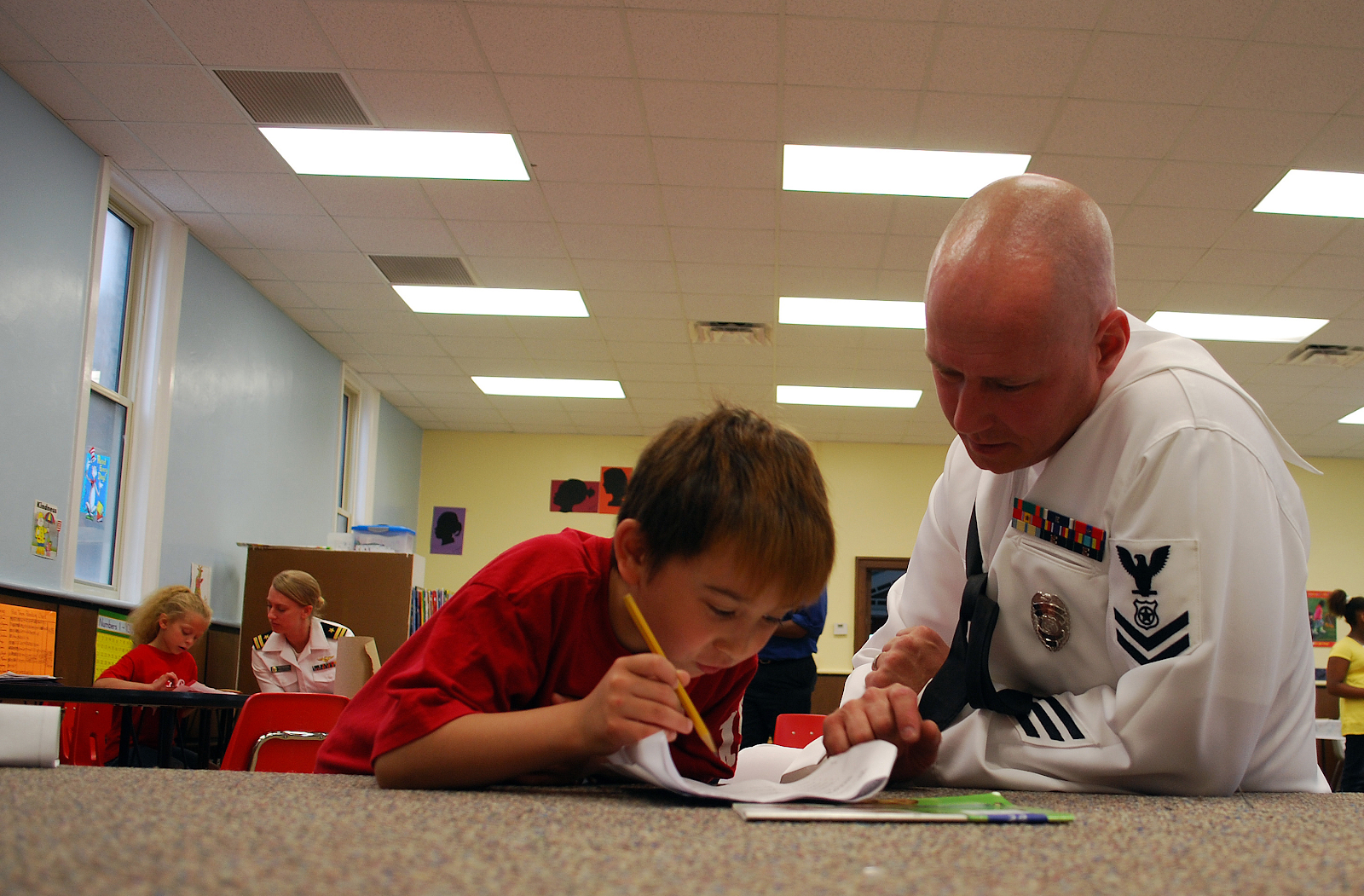
"Officer Helps Child With Homework at The Cameron Community Ministries After School Program" (2009) Wikicommons
Above the image shows a man helping a kids with homework, now he is just helping, and maybe writing something down on his sheet to help the kid. This isn’t plagiarism, it is just simply helping one person understand a concept.
Another way of understanding my proposed amendment is like when police officers use outside sources to help them with cases. They use the other outside sources for some help to get a little more information, so they can run with that information and get to solving whatever the problem is. In the end, the police officer gets the credit on that case, and even though s/he got some help, it was really all him/her. What I am saying is that if a police officer can use outside sources for help, and end up getting credit, why not a student that is using another student for help.
How will this new amendment help the GCE Community though? The community will grow, through students feeling encouraged to work together better, and be able to learn together, and teachers will see that all the work is understood, because each student will have different answers. My cosigner had this to say about my new amendment:
“I totally agree with this amendment because students should be encouraged to go to a friend to fully understand the concept that we learned in class. The way this amendment is clarified and now understandable there won’t be contradiction to it and if a student breaks this rule then there will be consequences.” -KIS
How might this connect to the actual Constitution? I would say this amendment is most connected to the first amendment of the U.S. Constitution because it shows we are allowed to work together, and mainly with freedom of the press, write whatever we want on a subject, with the ability to use outside resources. Now since that amendment is the first, it should allowed that a student who submits work of their own, with maybe some help, has not committed any infractions. To answer how this shows true citizenship, we must first define citizen: It is a member of a political country/community. Citizenship, is when that person follows all the laws that are in place in this country/community. Now having said that, my proposed amendment shows that because it very easy to follow now, since they can’t be attacked for simply helping someone in doing work.
In conclusion, I believe that it only right that the Code of Conduct change that section, to my revised edition immediately. There have already been many problems with section of the Code of Conduct, and changing it will make for a better GCE community in the end. Below are the main points of my argument: - P1: Section only really talks about blog.
- P2: Two students were claimed to have infracted on this rule, for simply helping, not turning word for word work.
- P3: We wouldn’t blame a police officer for using an outside source for help in a case.
- P4: This will help the GCE community become better.
- C: This new amendment is needed.
References:
"Citizenship Foundation: Educating for Effective Citizenship." Citizenship Foundation: What Is Citizenship. Web. 09 Mar. 2016.
Tuesday, March 1, 2016
Diddley Bow
In unit 2 of Light, Sound, and Time we focused on sound, how fast it can travel, and what it can travel fastest through. We also looked at waves, and how frequency plays a big role in understanding a wave, and with that we looked at the Doppler effect. Then we looked at instruments and how they produce sound, and how they can change frequencies, and this is how we learned about harmonics. Leading me to this action project, we are building a diddley bow, a type of guitar that only has one string on a piece of wood that uses a tin can. The materials used are a piece of wood (to use as a base), a tin can (to amplify the sound), a battery (to use a nut) and nails to hold everything down. I am most proud of having all materials in a short amount of time, and being able to build my guitar in the best way I could.
 |
| NVA "Diddley Bow" (2016) GCE Lab School |
 |
| NVA "Diddley Bow Drawing" (2016) GCE Lab School |
My diddley bow creates sound when the string vibrates, moving molecules in the air. The tin can helps with amplifying the sound to make it more audible. You could also use a slide on your string to check out different frequencies it can make. The diddley bow demonstrates a lot of key science concepts we went over like sound waves, because this is something that can actually produce sound waves. For frequency, it is shown by the tightness of the string we used, and the material we chose to use. From frequency we can then look at the wavelength and amplitude of the waves, and what they will look like. If it has a high pitch then the wavelength is shorter but the amplitude is the same. If it has a lower amplitude, then the volume is quieter.
The Doppler effect is where sound’s frequency can change according to a certain observer, when the source of the sound is moving. If I were running while playing my guitar and one man was standing behind, meaning I am running away from him, he would be hearing a lower pitch, because the sound waves get stretched out. If I were running towards him playing it, it would have a higher pitch because I am keeping up with the sound waves, so the frequency is higher.
For the string, the length is 15 inches and the thickness is 0.045 inches. To find the volume I need to do pi times radius squared times the height. The height is 4.25 inches and the radius is 1.6875, and using the formula, the volume of the guitar’s body (the can) is 38.02 inches cubed.

The picture above shows the harmonics involved with my guitar. Hertz (Hz) is the frequency unit, and centimeters are talking about the wavelength for each harmonic. To find each new harmonic you multiply the original frequency by whichever harmonic you are trying to find. So for the third I multiplied 117.92 by 3. For wavelength you do the opposite, you divide, so I would do 296.03 divided by 3.
I would not do anything differently, because I feel like I built my guitar in a special way, and that it turned out very well. One minor thing would be dulling the screws, because they do poke out of the bottom, which could be dangerous. Something I would do is sand them down, or just put a piece of wood under it to connect, so that they are completely covered. Below is audio of me playing my diddley bow.
The Doppler effect is where sound’s frequency can change according to a certain observer, when the source of the sound is moving. If I were running while playing my guitar and one man was standing behind, meaning I am running away from him, he would be hearing a lower pitch, because the sound waves get stretched out. If I were running towards him playing it, it would have a higher pitch because I am keeping up with the sound waves, so the frequency is higher.
For the string, the length is 15 inches and the thickness is 0.045 inches. To find the volume I need to do pi times radius squared times the height. The height is 4.25 inches and the radius is 1.6875, and using the formula, the volume of the guitar’s body (the can) is 38.02 inches cubed.

NVA "Diddley Bow Harmonics" (2016) GCE Lab School
The picture above shows the harmonics involved with my guitar. Hertz (Hz) is the frequency unit, and centimeters are talking about the wavelength for each harmonic. To find each new harmonic you multiply the original frequency by whichever harmonic you are trying to find. So for the third I multiplied 117.92 by 3. For wavelength you do the opposite, you divide, so I would do 296.03 divided by 3.
I would not do anything differently, because I feel like I built my guitar in a special way, and that it turned out very well. One minor thing would be dulling the screws, because they do poke out of the bottom, which could be dangerous. Something I would do is sand them down, or just put a piece of wood under it to connect, so that they are completely covered. Below is audio of me playing my diddley bow.
Monday, February 15, 2016
Shooting Creativity
In unit 1 of my new course A Nation's Argument, we focus on what makes a good argument. We defined argument, which comes from the Latin word meaning to clarify. We learned about the structure of arguments, by looking at the Declaration of Independence that America wrote to the British. We also looked at art, and how that can also be used to make an argument, or just show the reality of a subject, which is an effort at making something clear. For the action project, we had to make our own Declaration of Independence about a class/course we would want to exist in our school. Something I liked about this was that we got to chose our class, something that means a lot to us. I would say a challenge was actually coming up with an idea because in my class, a lot of people’s ideas overlapped. Please enjoy my Declaration of Independence!
The guiding question to this course called , “Shooting Creativity”, is: What can one film do to one person? Think about that, too, because hasn’t a film made you cry, or laugh to the point of crying? I have felt a lot from movies -- they let me into new things, explore my imagination, and be able to see the realness in a subject that sometimes you just can't get from a book. I feel like many other people feel this way, and I want them to be able to have the skills and tools they need to pursue their dreams of exploring this artistic medium.
This course will be offered during the elective term of the school year, because it is neither a STEAM or Humanities course, but in a way both, since there will be a science to the editing, and history will be added to the units. There will be three units: the first unit, called “Act”, will be focusing on acting; the different types there are; what it is like to be on stage versus being on set; and how to be a strong wonderful actor. We will also look at great actors and what makes them so good, how a comedy actor can differ from a drama one, and what can also connect them. The second unit, called “Shooting”, will focus on how to properly film, what makes a good location to film at, and different angles and what they can convey. The last unit, called “Tweak”, will focus on editing, and all the pieces that go into it, including adding special effects, changing the lighting, and trimming and adding stuff in.
My desired outcomes for this class, are for people to learn how to make a great film, by actually learning the editing, camera work, and acting, among other things, that all go into making a wonderful film. This class will take students and bring them into a wonderful world where they can make their own films, and they can explore the kinds of things they like in films. Though certain students will need a lot of different materials; course materials include cameras for shooting, editing software for everyone, and possibly a partnership with a improv place, such as iO Chicago, which is a few blocks from the school. Improv actors are amazing at doing things on the spot, so if there were actors in need, and they would be partnered with us, hopefully they could help. We could even visit them for an FE and learn how acting to them is different from acting to other actors, learning about what they have to do differently.
P1: Film can offer a person something that is very important.
P2: Films can release many emotions in one person.
P3: This course will focus on acting, filming, and editing.
P4: This course will turn someone into an expert on making a film.
C: “Shooting Creativity” should be a class in the GCE School curriculum.
 |
| NVA "Expert Film Maker Graph" (2016) |
I declare that there be “Filming Creativity” where students can learn all aspects of filmmaking -- camera work, editing, and acting skills. This all will help develop well-rounded, enthusiastic, curious students learn much more, by building the skills to adapt and be open to new things, and make the best films that a high school student could ever make!
Tuesday, February 9, 2016
Lights, Camera, Action!
In unit 1 of Light, Sound, and Time, we explored more trigonometry and got in deep with it. We also talked about light, whether it is a particle or wave. Next we looked at colors, and how we are able to see colors, and what they are on the electromagnetic spectrum. We also looked at the human eye, and how it is similar to a camera. Leading me to the action project, we have to make a pinhole camera out of household materials, and create an image with it. With that we have to use the math we have learned and make similar triangles, from the box to what the image will be. The object used in the calculations is different from my actual image, because we needed something that was taller than the height of the pinhole camera. I really liked how we used household items to make a thing that can actually take a picture with film; it honestly amazes me that that is possible. Please enjoy seeing my camera, and the picture I was able to take with it.
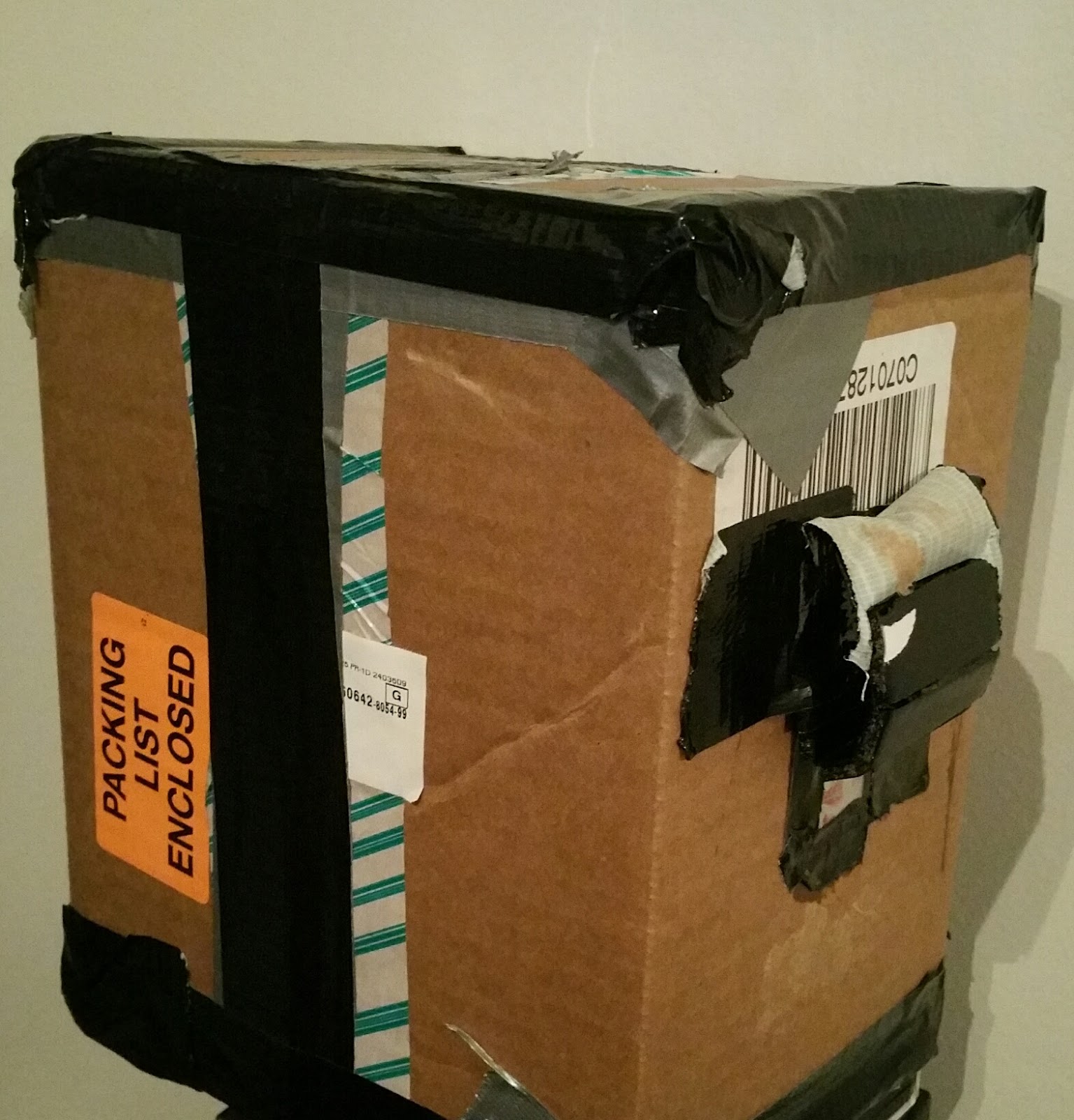 |
| NVA "Pinhole Camera Side View" (2016) GCE Lab School. |
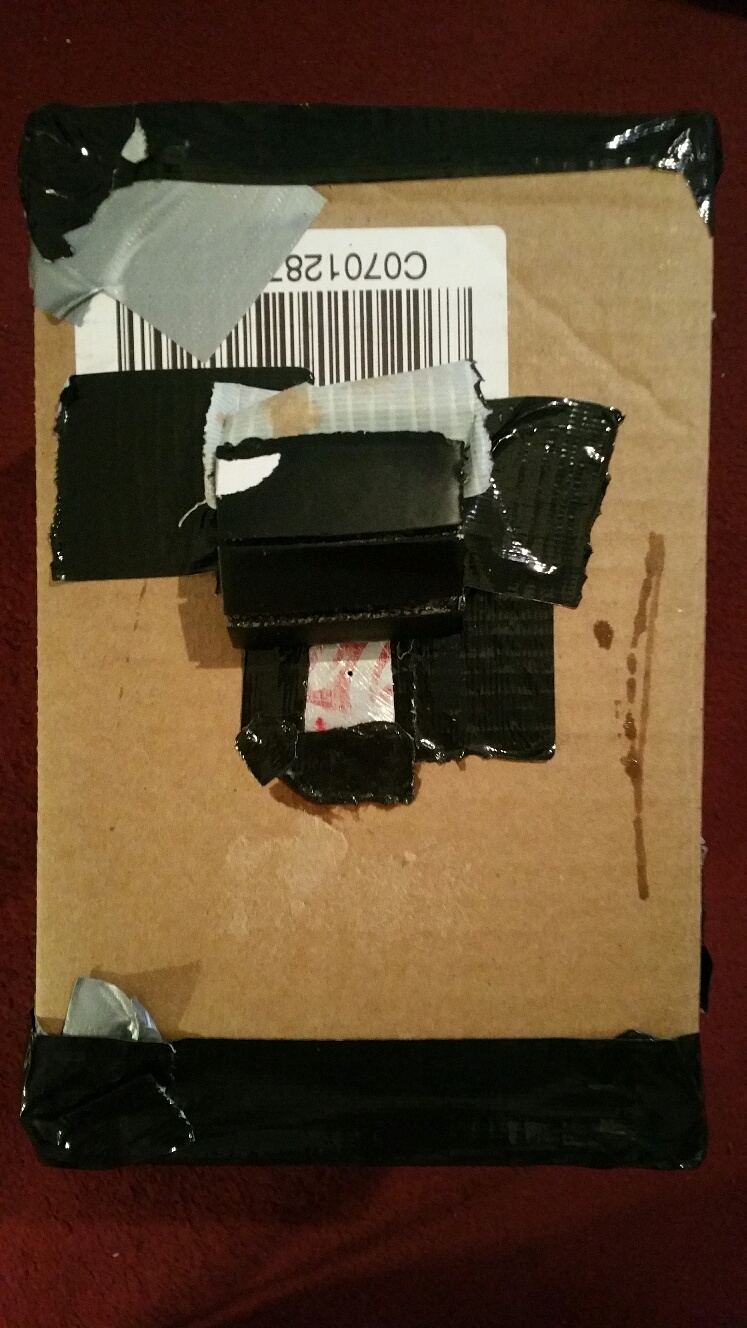 |
| NVA "Pinhole Camera Top View" (2016) GCE Lab School. |
 |
| NVA "Light in Pinhole Camera Example" (2016) GCE Lab School. |
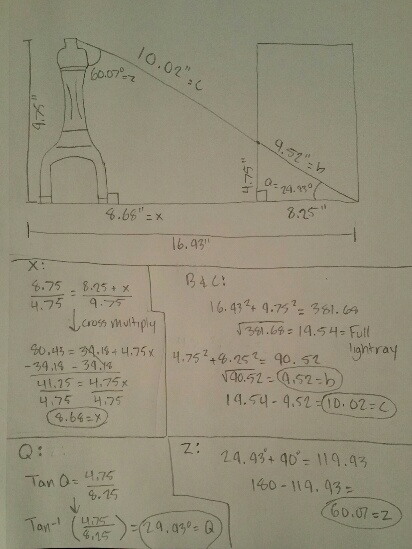 |
| NVA "Pinhole Camera Similar Triangles" (2016) GCE Lab School. |
 |
| NVA "Yoshi Pinhole Picture" (2016) Latin School. |
For the picture, the shutter speed was about 3 minutes, so the film had enough time to absorb all of the light, leading to a better picture. If I were to do this again, I would play around with the times of the shutter speed, so I could get the perfect image. Also I would like to be able to re-position the camera, so that it could get everything in the picture a lot better. I had more objects, a yoyo and a Rubic cube, under the Yoshi that I wanted in the picture. I would probably want to put something underneath to raise the Yoshi and the things it was on.
Subscribe to:
Posts (Atom)