For unit 2 of Design and Engineering, we learned about Newton’s First Law of Motion, Inertia, looked at more Trigonometry and did Calculus. For the action project we, with a partner, received a persona and what they needed out of a bike. We then had to create an actual 3D model of a bike that would fit what they needed for their biking experience. I had a person named Andres and because of the problems his grandmother wanted him to avoid, my partner and I made a bike below that fits his needs. What I liked about this project was making the bike and getting to know how far I could go with making it. What I didn’t like was that there were times when my partner and I didn’t see eye to eye, but we were able to overcome those problems. Please enjoy our design.
Before making these bikes, we did some research on bikes and how they worked. One thing I learned was that gears are actually more important than a lot of people may think. They actually really help the bike do certain tasks. Something else I learned was that different materials for the frame can change how the bike will perform. A lot of road bikes have a carbon fiber frame, and hybrid/ mountain bikes will have a stainless steel frame. The carbon fiber is very light, making it easier for the rider on a street to go fast, whereas a hybrid/mountain bike rider will need the steel frame for a more durable ride. For an interview I completed, a biker said, “I would actually like my frame, because it fits my riding, where I will be all over the place.”
The person I have, as I said before, is Andres. His grandmother wants to get him a bike that will be safe and comfortable for him to ride, and it also has to be good against harsh weather. His route includes having to go through the park and cutting into alleys and rocky roads to get to school and back. The normal part of the bike is that it is a mountain bike, with wheels made for all grounds and stainless steel to protect from rust. But what makes it different from other bikes? It’s very different from many other bikes, because it has gloves that make it easier to grip the bars. It has an umbrella that you can take on and off when it’s raining or snowing. It has a molded seat to fit your body comfortably. The gloves and seat make it more comfortable for the user, mainly so the body isn’t so stressed. The umbrella is for the harsh weather to come, and the wheels are thick to make riding on all grounds easier; it also has shock absorbers like a mountain bike, for Chicago potholes. The we decided it will be called The Wing, because it is like the expression, “you are under my wing.” because for the fact that every parents want to take care of their kid, so you now have a bike that does the same.
 |
| NVA. "Wing Sketch/" (2015). GCE Labs School |
Now to talk about the bike mathematically, we have a wheel that is theoretically 28 inches tall to get over land easier, making the circumference about 88 inches. His commute takes him 26 min, when riding about 7 mph or 3.13 meters per second, because the route that Andres takes is 3.2 miles, using Lincoln Park, and alleys. On that journey his wheels rotate about 2304 times. Now the wheel used in the model is 1 inches compared to the theoretically 28 inches. Now to make it a faster ride my partner and I chose to have the biggest cog in front and the smallest in back to have Andres go faster. The bike will have multiple gears, but we'll range the gear ratio, since the biggest front gear has 53 teeth and the smallest back gear has 13 teeth which makes it a 1:4 gear ratio. Then the smallest front gear is 35 teeth, and the largest back one has 26, which gives you a 26:35 ratio.
Now when talking about bikes, physics play a huge role such as energy and the different types, like Potential and Kinetic. For this bike and the rider, potential energy will be shown when Andres is on top a small hill because there is more gravity pulling down. He will have the most kinetic when riding in the alleys, because he is going straight and releasing his energy.
We did have to think of certain things though, like how the umbrella would be aerodynamic and how it could fit the rider. We just made it more pointy at the front, so the wind goes over it instead of through. Another concern was how the gloves would work, and we thought of making them more like mittens so people could have more hand space and warmth. We also wanted to make it where Andres could ride without them, and he could just hold onto the mittens for a comfortable grip when riding.
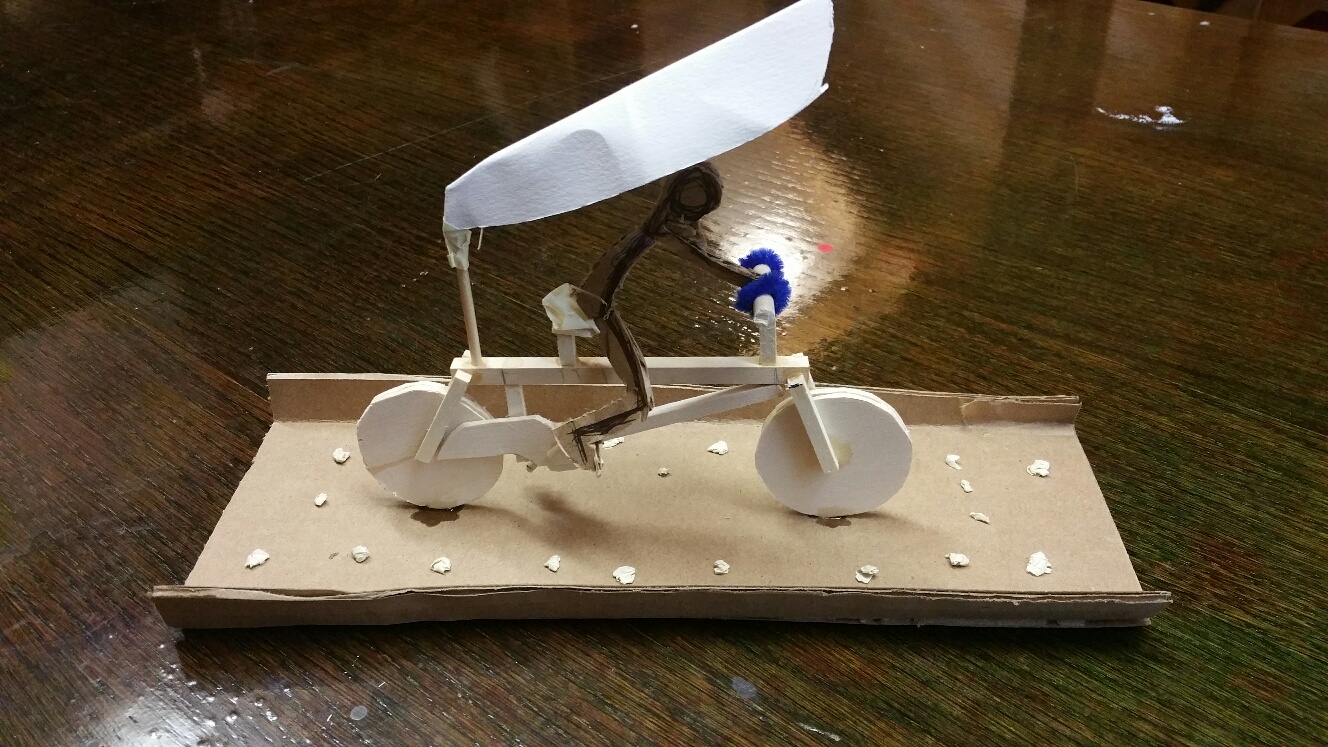 |
| NVA. "Wing 3D Without person." (2015) GCE Labs school |
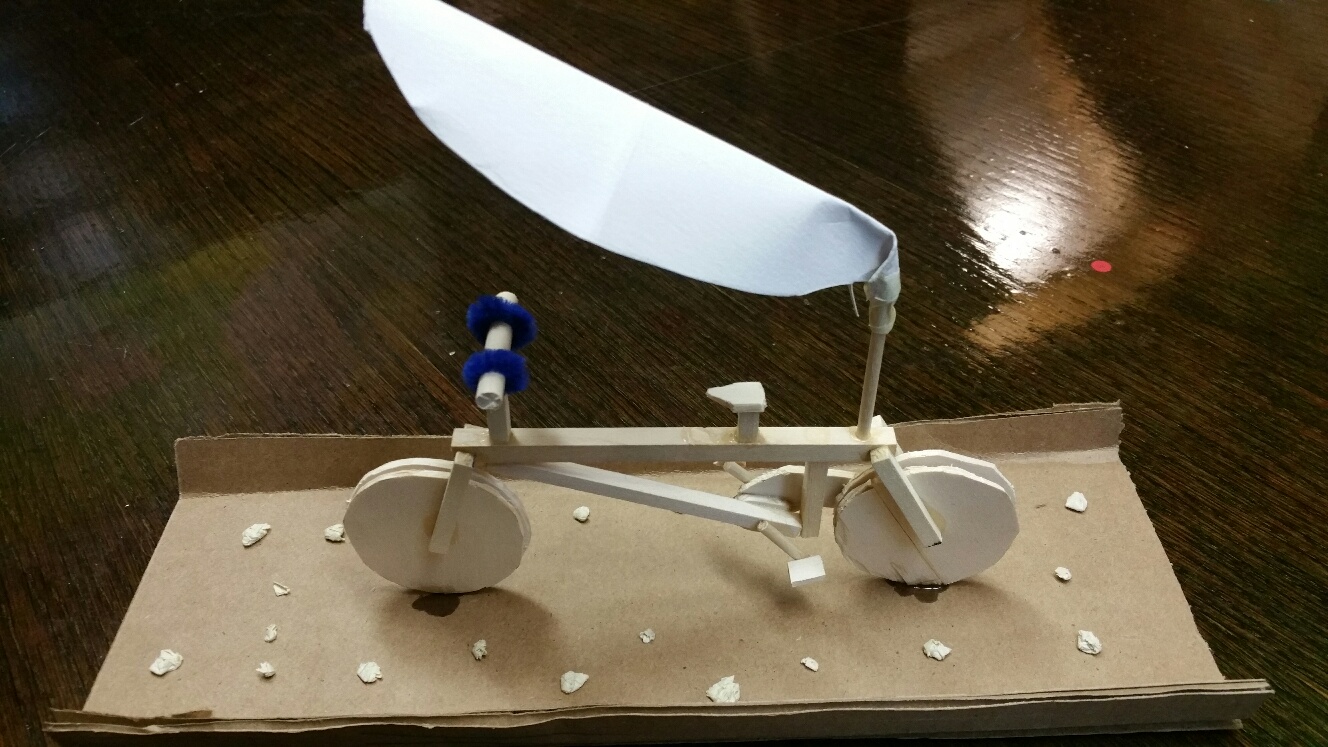 |
| NVA. "Wing with 3D With Peron." (2015) GCE Labs School |


